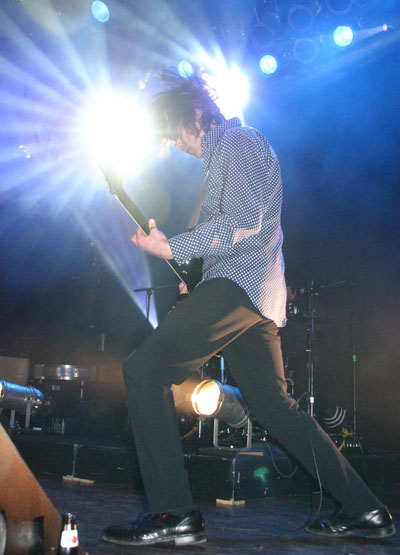
My main motivation for creating this game project is straight forward, in that it was something I wanted that did not exist.
Why did I want this?
When I was a young man, gigging in the Ottawa area, my band faced a big problem. None of the rock bars would book us because we were considered a ‘punk rock’ act and they were still living in the 70’s, when the bands they booked tended to have a drum solo in their set and the members had permed haircuts and wore satin kimonos. We were not like that so it was next to impossible to get booked in those places. We resorted to booking restaurants for a ‘party’. We had a friend who had built his own PA system and I helped with some of the woodworking. We fashioned our own stage out of plywood and milk crates and we would rent some lights. It was a lot of loading and lifting we had to do for every show. Doing all of this was risky because we had no money and relied upon door revenue to pay for it. The lights often caused the power in the establishment to overload.
Come the night of the ‘party’ we had booked, the restaurant establishment would get nervous when they saw what we were actually up to. As well, some of the attending guests would behave really poorly, believing that being a punk rocker meant you had to spit and break things. We would finish the first (of three planned sets) and the establishment manager would tell us to pack up our shit and get out. This happened a few times until we found a restaurant, across the river on the main drag in HULL, Quebec, called “The Chandelier”. They liked us because we helped them sell a lot beer. Apparently, we brought them the most business they had seen in a while at a time when there was a wicked recession in early 1981. This room was run by a Lebanese family and the Quebecers were notoriously xenophobic back then. So, they liked us at this place and we did a number of shows there. We even brought DOA in for a double bill (with the original lineup), who gave our home made stage a really solid workout.
Over time, we started to build a reputation around Ottawa and the established rock bars began to take notice of us. We got booked and no longer needed to lug in our own homemade PA and stage just to do one gig.
Fast forward about 7 years and I had now moved to Toronto where no-one knew me and my old band was forgotten. I had only been a front man and singer but, still wanting to play music, I bought my first guitar at age 27 and began the long, slow effort of learning how to play an instrument.
By the time I was ready to perform again, the live music club scene had changed dramatically since 1980. There were no more three night bookings that paid you money. What you got was a time slot after three or four other acts, in exchange for payment of a few beer tickets. It really sucked for the bands who worked really hard to present a good show. The people who came out were mainly just friends and family of the different acts and each audience would stay only for the performers they came out to see. I shuffled around in different bands for a few years trying to get things going but it was so much work all while I also needed to do well at my full time job to pay the bills.
Eventually, I just gave up and focused on playing acoustic guitar. During this period I started to get serious about writing my own material. In the past I had always worked with a guitar player better than I — Steve Gelling, Scott Casey and Gary DeJong. Previously, I only wrote the lyrics, and, they wrote the music, but now I’d gotten to the point that I had ten original songs that I’d written myself.
Computer games at this time were developing rapidly and I remember playing DOOM from a diskette. Then, I noticed SIMS and this was when I started to think about a real-life type of game concept, with real performers. I loved the idea but implementation was way out of reach for me. I did notice there were some games that featured nightclub type scenarios with on stage avatar performers but it was all a produced action, not actual musicians. It was not live and I thought, “boy, here is an opportunity for these big game companies like Eidos and Rockstar to add some compelling action into their game play”. But that never happened.
Ten years later I learned about “Second Life”. This was interesting to me. So, I opened an account and explored the 3d open world model. It was here that I finally began to see a way to make my vision become reality. I built a nightclub in-game and used my technical radio production skills to enable my band to perform live streamed music within the game environment. It was difficult and kind of corny because you had to represent yourself in avatar form within Second Life. So, I had this little cartoon man representing me holding a guitar. We did this for about five years, performing a full hour set, three to four times per week. We were different from almost every other performer in this game. We were playing original music and they were just covering popular music.
This is when I noticed something really interesting for our band. In the real world of live, original music it is highly unusual for anyone to see any act more than three times ever. This is why you have to tour because you quickly exhaust your local market. However, in this game world we had people regularly attending our shows, via their home computers, each week. Some folks would have seen us perform hundreds of times. It was like radio where people have habitual weekly listening patterns. Some of these people even became our friends in real life.
If you do not play often enough your act does not get tight. You have to be tight as an act and without practicing and or performing at least three times a week you will just never get there. Second Life allowed my band to stay really tight because we had as many chances to play as we wanted. People would book us to perform as avatars at their virtual weddings and birthday parties, around the world. We were paid with the in-game currency and this was convertible into real money. It was not a lot, perhaps $30 USD per show, but it was more than six stupid beer tickets were worth.
Second Life was good but it was still not enough for me. There were some big problems in the game structure in my opinion. In their desire to expand their platform, the developers had ruined the tension in the open world by adding thousands of hectares of space overnight. There weren’t enough regular players for that much space so this sapped the energy and you could travel for large distances and never encounter another player. They also allowed the search tool they had built in game to become spammed by DJs ( people with Spotify accounts) who presented this streamed, recorded music, as being a “live music performance”. It became hard to reach folks with our gig notices amongst all the deceptive listings . Essentially, I felt we had done a lot to create a unique thing in game but were being completely ignored by the Second Life team. Not once did I ever meet any of them at our shows nor receive any sort of contact or recognition for what we were actually doing. They did not seem to care that live original music was being streamed performances into their game platform.
It was also really disappointing to me that some of my friends in real-life refused to join me in this world by coming to a show. I knew they played computer games all the time but for some reason they just could not be bothered downloading and installing the software and creating an account with Second Life. So, I eventually concluded that the barrier to entry was too high and I needed a different way to get what I needed to do, done.
This required being able to program what I envisioned building, myself. So, I went back to university for night school, studying Computer Science — two classes per week, three hours each lecture for four years. I should have done this the first time around at University. I had previously studied Radio and Television. Personal computers were not common back then so I did not really think computer science was for me.
It is my deep knowledge of radio broadcasting, live music and computers that enables me to put this all together. I would love to meet someone else who has the same kind of background so I could share ideas but I don’t think those people are in Toronto or anywhere in Canada for that matter. In Second Life I did meet a guy from Florida named Casey that also understood what I was doing. He had a good act that was like ours and I think we inspired him to perform online like we were doing.
So, long story short, I am trying to offer a way for real musicians to perform their original music in front of a real audience without having to lug your gear, drive your van, eat bad food and get old quickly. Most live music clubs are only interested in selling booze and I don’t care to help them do this.
I know most serious original music acts will have access to a mixer, a microphone and audio software already. They just need to get a camera and a computer to stream their performance in order to play in “The Rehearsal Space” game. I believe doing so regularly will enable them to develop their act and keep it tight. Ultimately, I want this project to be operating 24/7 with performers from all around the world. We will see if we get there but starting out, it will just be me and my partner performing our duo act to get things going. Once other musicians see what we are up to I believe they will want to join us, especially if there is some real money to be had.
This game is just a web page. This means it is highly accessible and the barrier to entry is very low. I built it using a laptop that is at least ten years old on purpose, because I need it to work on equipment that is not the top-of-line. I do recommend using the BRAVE browser. It is the best browser for this experience. The game will feel a lot more primitive than a console-like gaming experience but, I don’t care. It does what I need it do now and It will get better over time.